BestNovel
Search series
NovelAudioCategoryLibrary

World

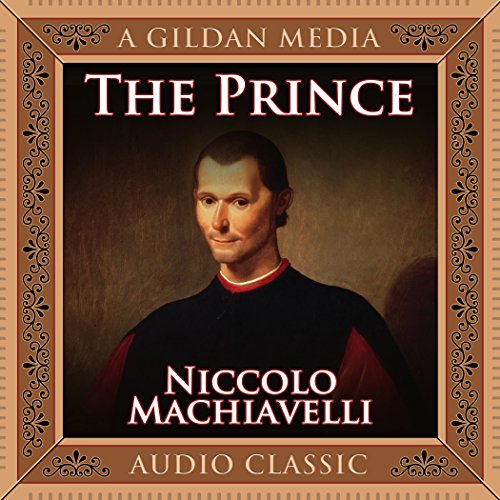
The PrinceGrover Gardner8.60
Publisher's Summary From his perspective in Renaissance Italy, Machiavelli's aim in this classic work was to resolve conflict with the ruling prince, Lorenzo de Medici. Machiavelli based his insights on the way people really are rather than an ideal of how they should be. This is the world's most famous master plan for seizing and holding power. Astonishing in its candor The Prince even today remains a disturbingly realistic and prophetic work on what it takes to be a prince, a king, or a president. When Machiavelli was removed from his post in his beloved Florence, he resolved to set down a treatise on leadership that was practical, not idealistic. The Prince he envisioned would be unencumbered by ordinary ethical and moral values. Even today, this sixteenth-century classic has become essential listening for every student of government, and is the ultimate audiobook on power politics. Public Domain (P)2013 Gildan Media LLC
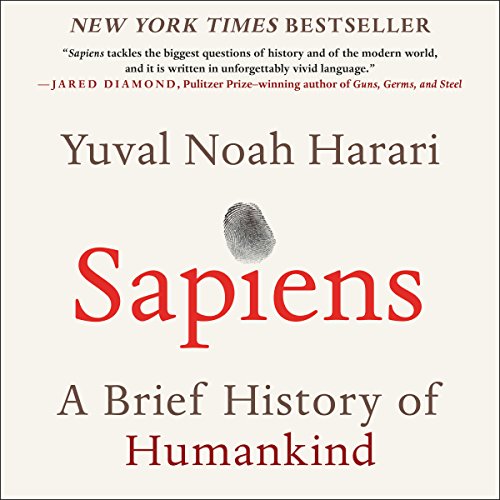
SapiensDerek Perkins9.40
Publisher's Summary From a renowned historian comes a groundbreaking narrative of humanity's creation and evolution - a number one international best seller - that explores the ways in which biology and history have defined us and enhanced our understanding of what it means to be "human". One hundred thousand years ago, at least six different species of humans inhabited Earth. Yet today there is only one - Homo sapiens . What happened to the others? And what may happen to us? Most books about the history of humanity pursue either a historical or a biological approach, but Dr. Yuval Noah Harari breaks the mold with this highly original book that begins about 70,000 years ago, with the appearance of modern cognition. From examining the role evolving humans have played in the global ecosystem to charting the rise of empires, Sapiens integrates history and science to reconsider accepted narratives, connect past developments with contemporary concerns, and examine specific events within the context of larger ideas. Dr. Harari also compels us to look ahead, because, over the last few decades, humans have begun to bend laws of natural selection that have governed life for the past four billion years. We are acquiring the ability to design not only the world around us but also ourselves. Where is this leading us, and what do we want to become? This provocative and insightful work is sure to spark debate and is essential for aficionados of Jared Diamond, James Gleick, Matt Ridley, Robert Wright, and Sharon Moalem. ©2015 Yuval Noah Harari (P)2017 HarperCollins Publishers
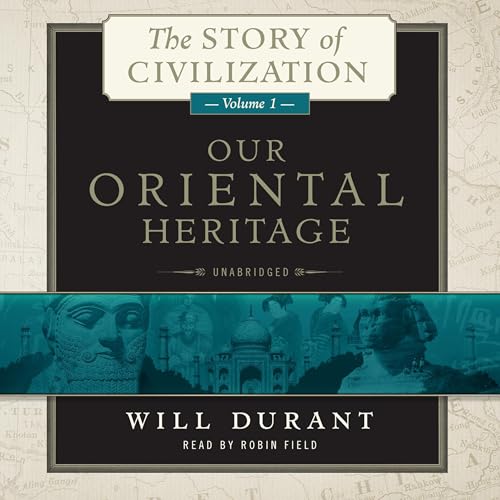
Our Oriental Heritage (The Story of Civilization)Robin Field9.10
Publisher's Summary The first volume of Will Durant's Pulitzer Prize-winning series, Our Oriental Heritage: The Story of Civilization, Volume I chronicles the early history of Egypt, the Middle East, and Asia. In this masterful work, readers will encounter: Sumeria, birthplace of the first cities and written laws the Egyptians, who perfected monumental architecture, medicine, and mummification more than 3,500 years ago the Babylonians, who developed astronomy and physics, and planted the seeds of Western mythology the Judeans, who preserved their culture forever in the immortal books of the Old Testament the Persians, who ruled the largest empire in recorded history before Rome Indian philosophy, Chinese philosophers, and Japanese Samurais ©2013 Will Durant (P)2013 Blackstone Audio, Inc.
Discourses: Complete Books 1-4Greg Douras9.30
Publisher's Summary The Discourses of Epictetus are a series of extracts from the teachings of the Stoic philosopher, Epictetus. This is the complete version, containing books one through four. ©2018 James Harris (P)2018 James Harris
The History of RumJohn Donoghue8.20
Piña coladas. Mojitos. Hurricanes. Daiquiris. Mai tais. Nothing makes a vacation like one of these delightful rum drinks, right? But whether blended with ice and fruit or sipped neatly from a glass tumbler, this sweet and fiery spirit brings with it a fascinating, complicated history that stretches back to colonial times of the 17th century in the Caribbean. "The history of rum is a tale of both sweetness and sorrow," says historian John Donoghue of Loyola University, Chicago. And, as he puts it, "If told correctly, much like a good bottle of Jamaican overproof, it burns while it inspires." Professor Donoghue does just that in the Audible Original The History of Rum . Blending politics and economics with culture and beverage appreciation, these 10 lessons reveal how the history of rum not only shaped the drinking culture of the early modern and modern worlds, but how it also helped determine the wider histories of piracy, slavery, abolition, and global capitalism. Explore the invention of rum as a liquor so strong it was called "kill-devil". Discover classic colonial drinks like flip and stone fence. Meet the real Captain Morgan, who pillaged the Spanish Main for capital to build Jamaica's rum industry, and learn how rum played a crucial role in the early campaigns of George Washington. Chart rum's growing profitability in international markets, which spurred everything from the transatlantic African slave trade to the American Revolution. Above all, enjoy a 10-lesson toast to 400 years of rum - in all its tragic glory.
Less Is MoreBen Crystal, Clifford Samuel9.50
Publisher's Summary Brought to you by Penguin.  The world has finally awoken to the reality of climate breakdown and ecological collapse. Now we must face up to its primary cause. Capitalism demands perpetual expansion, which is devastating the living world. There is only one solution that will lead to meaningful and immediate change: degrowth. If we want to have a shot at halting the crisis, we need to restore the balance. We need to change how we see nature and our place in it, shifting from a philosophy of domination and extraction to one that's rooted in reciprocity and regeneration. We need to evolve beyond the dogmas of capitalism to a new system that is fit for the 21st century. But what does such a society look like? What about jobs? What about health? What about progress? This audiobook tackles these questions and traces a clear pathway to a post-capitalist economy. An economy that's more just, more caring and more fun. An economy that enables human flourishing while reversing ecological breakdown. An economy that will not only lift us out of our current crisis, but restore our sense of connection to a world that's brimming with life. By taking less, we can become more.   PLEASE NOTE: When you purchase this title, the accompanying PDF will be available in your Audible Library along with the audio.   ©2020 Jason Hickel (P)2020 Penguin Audio
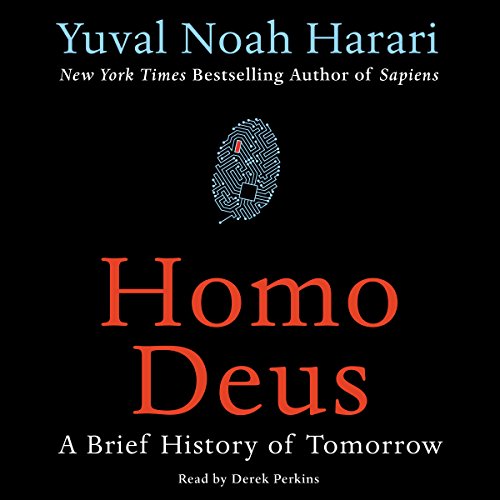
Homo Deus (Sapiens)Derek Perkins
Publisher's Summary Yuval Noah Harari, author of the critically acclaimed New York Times best seller and international phenomenon Sapiens , returns with an equally original, compelling, and provocative book, turning his focus toward humanity's future and our quest to upgrade humans into gods. Over the past century, humankind has managed to do the impossible and rein in famine, plague, and war. This may seem hard to accept, but as Harari explains in his trademark style - thorough yet riveting - famine, plague, and war have been transformed from incomprehensible and uncontrollable forces of nature into manageable challenges. For the first time ever, more people die from eating too much than from eating too little; more people die from old age than from infectious diseases; and more people commit suicide than are killed by soldiers, terrorists, and criminals put together. The average American is 1,000 times more likely to die from binging at McDonalds than from being blown up by Al Qaeda. What then will replace famine, plague, and war at the top of the human agenda? As the self-made gods of planet Earth, what destinies will we set ourselves, and which quests will we undertake? Homo Deus explores the projects, dreams, and nightmares that will shape the 21st century - from overcoming death to creating artificial life. It asks the fundamental questions: Where do we go from here? And how will we protect this fragile world from our own destructive powers? This is the next stage of evolution. This is Homo Deus . With the same insight and clarity that made Sapiens an international hit and a New York Times best seller, Harari maps out our future. ©2017 Yuval Noah Harari (P)2017 HarperCollins Publishers
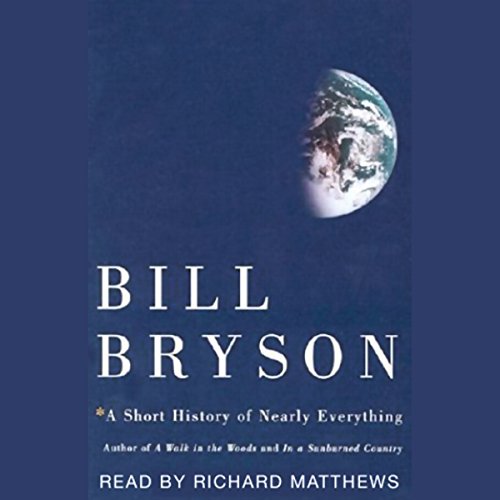
A Short History of Nearly EverythingRichard Matthews
Publisher's Summary One of the world’s most beloved and best-selling writers takes his ultimate journey - into the most intriguing and intractable questions that science seeks to answer.  In a Walk in the Woods , Bill Bryson trekked the Appalachian Trail - well, most of it. In In A Sunburned Country , he confronted some of the most lethal wildlife Australia has to offer. Now, in his biggest book, he confronts his greatest challenge: to understand - and, if possible, answer - the oldest, biggest questions we have posed about the universe and ourselves. Taking as territory everything from the Big Bang to the rise of civilization, Bryson seeks to understand how we got from there being nothing at all to there being us.  To that end, he has attached himself to a host of the world’s most advanced (and often obsessed) archaeologists, anthropologists, and mathematicians, travelling to their offices, laboratories, and field camps. He has read (or tried to read) their books, pestered them with questions, apprenticed himself to their powerful minds.  A Short History of Nearly Everything is the record of this quest, and it is a sometimes profound, sometimes funny, and always supremely clear and entertaining adventure in the realms of human knowledge, as only Bill Bryson can render it. Science has never been more involving or entertaining.  ©2003 Bill Bryson (P)2003 Books on Tape, Inc. Published by Arrangement with Random House Audio Publishing Group, A Division of Random House, Inc.

Loading more

Loading more

LibraryNovelAudioCategoryMe