BestNovel
Search series
NovelAudioCategoryLibrary

Europe

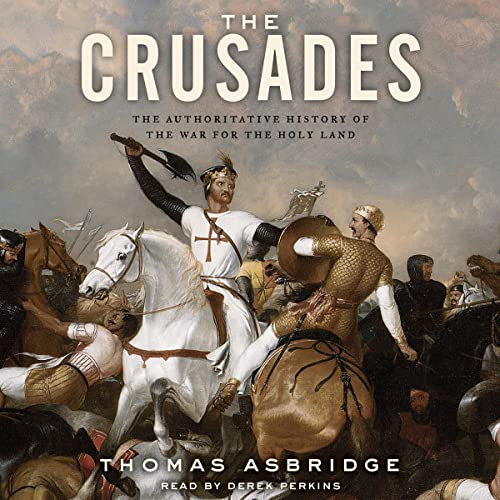
The CrusadesDerek Perkins9.20
Publisher's Summary The Crusades is an authoritative, accessible single-volume history of the brutal struggle for the Holy Land in the Middle Ages. Thomas Asbridge - a renowned historian who writes with "maximum vividness" (Joan Acocella, The New Yorker ) - covers the years 1095 to 1291 in this big, ambitious, listenable account of one of the most fascinating periods in history. From Richard the Lionheart to the mighty Saladin, from the emperors of Byzantium to the Knights Templar, Asbridge's book is a magnificent epic of holy war between the Christian and Islamic worlds, full of adventure, intrigue, and sweeping grandeur. ©2010 Thomas Asbridged (P)2016 HarperCollins Publishers
The Age of Faith, Volume 4 (The Story of Civilization)Stefan Rudnicki9.40
The Age of Reason Begins (The Story of Civilization)Grover Gardner9.50
Publisher's Summary This seventh volume of Will and Ariel Durant's renowned Story of Civilization chronicles the history of European civilization from 1558 to 1648. The Age of Reason Begins brings together a fascinating network of stories in the discussion of the bumpy road toward the Enlightenment. This is the age of great monarchs and greater artists - on the one hand, Elizabeth I of England, Philip II of Spain, and Henry IV of France; on the other, Shakespeare, Cervantes, Montaigne, and Rembrandt. It also encompasses the heyday of Francis Bacon, Galileo, Giordano Bruno, and Descartes, the fathers of modern science and philosophy. But it is equally an age of extreme violence, a moment in which all Europe was embroiled in the horrible Thirty Years' War - in some respects, the real first world war. This chapter in cultural history is one that can't be missed. ©1961 Will and Ariel Durant (P)2015 Blackstone Audio, Inc.
The Age of Voltaire (The Story of Civilization)Grover Gardner9.50
Publisher's Summary The Age of Voltaire , the ninth volume of The Story of Civilization, is an in-depth examination of France and England in the first half of the 18th century. In this masterful work, listeners will encounter: The English ideas that inspired the Enlightenment in France - skepticism, scientific experiment, constitutional government, "natural rights", and individual liberty The salons of Paris, where the wits and thinkers of all Europe gathered to exchange ideas The philosophers - intellectuals, playwrights, and poets who consulted and consorted with kings and queens Voltaire himself - the incarnation of the Enlightenment and a devotee of reason who still defended religious faith Mme. Pompadour, patron of the philosophers, who seduced King Louis XV and through him influenced French policy The Augustan Age in English literature - Alexander Pope's poetry, Jonathan Swift's satires, and the novels of Samuel Richardson and Henry Fielding ©2015 Will and Ariel Durant (P)2015 Blackstone Audio, Inc.
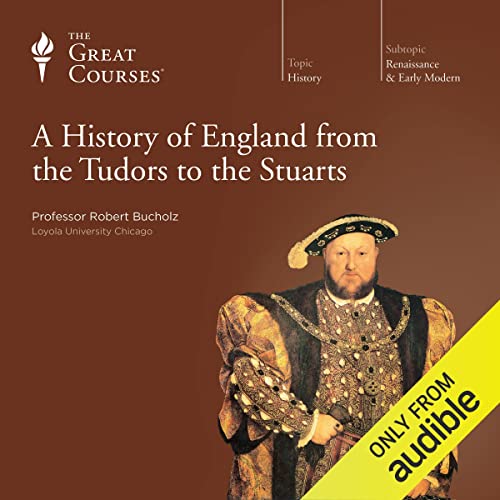
A History of England from the Tudors to the Stuarts (The Great Courses Renaissance ERobert Bucholz9.50
During the 229-year period from 1485 to 1714, England transformed itself from a minor feudal state into what has been called "the first modern society" and emerged as the wealthiest and most powerful nation in the world. Those years hold a huge and captivating story. The English survived repeated epidemics and famines, one failed invasion and two successful ones, two civil wars, a series of violent religious reformations and counter-reformations, and confrontations with two of the most powerful monarchs on Earth, Louis XIV of France and Philip II of Spain. But they did much more than survive. They produced a great culture, giving the world the ideas of John Locke, the plays of Shakespeare, the wit of Swift, the poetry of Milton, the buildings of Christopher Wren, the science of Isaac Newton, and the King James Bible, to name a very few. And, despite the cruelty, bloodshed, and religious suppression they visited upon so many, they ultimately left behind something else: the political principles and ideals for which we-and so many of them - would work and die, and on which we would build our own nation. Now you can watch this remarkable panorama of society, economics, religion, and politics unfold in a series of 48 transfixing lectures by a justifiably honored teacher who takes you into the lives of not only Britain's ruling royal houses, but the English people themselves, describing how they were born, worked, played, worshiped, fell in love, and died. Cinematic in their presentation and detail - whether describing the likely thoughts of Charles I on the way to his execution or the overheard weeping of Queen Anne after she fired her Lord Treasurer - these lectures are as memorable as the history they describe.

Rousseau and Revolution (The Story of Civilization)Stefan Rudnicki9.60
Publisher's Summary A History of Civilization in France, England, and Germany from 1756, and in the Remainder of Europe from 1715 to 1789 The Pulitzer Prize-winning volume on European civilization by acclaimed historians Will and Ariel Durant. Rousseau and Revolution , the 10th volume of the Story of Civilization, ranges over a Europe in ferment, but centers on the passionate rebel-philosopher Jean-Jacques Rousseau, the great exponent of the romantic impulse toward self-exploration and social revolt, who contended with the great rationalist Voltaire for the mind of Europe. Rousseau condemned civilization as a disease, glorified the noble savage, proclaimed to the world with equal intensity his own love affairs and the natural rights of man, and became the patron saint of the revolution and the worldwide social upheavals of two centuries. ©1967 Will and Ariel Durant (P)2015 Blackstone Audio, Inc.
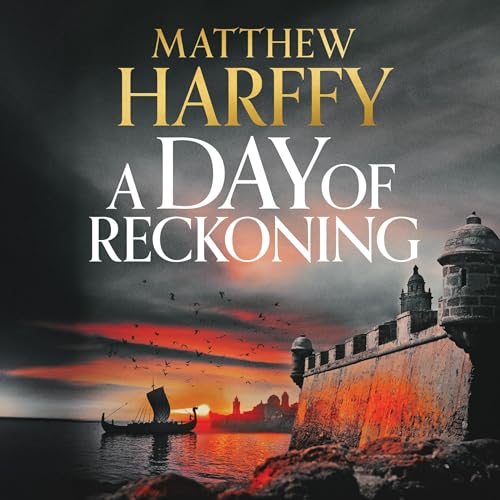
A Day of Reckoning (A Time for Swords)Barnaby Edwards9.60
Hunlaf battles peril and intrigue on a dangerous voyage to Muslim Spain. AD 796. Sailing in search of an object of great power, Hunlaf and his comrades are far from home when they are caught up in a violent skirmish against pirates. After the bloody onslaught, an encounter with ships from Islamic Spain soon sees them escorted under guard to the city of Qadis, one of the jewels of the Emirate of Al-Andalus and the true destination of their voyage. Hunlaf believes the Emir's lands hold the key to his search, but there are dangerous games at play. To achieve his goal, Hunlaf and his allies must walk a difficult path where friends and enemies alike are not always what they seem—and where a weapon deadlier than any yet seen could change the future of all the kingdoms in Europe. The third thrilling historical adventure in the A Time for Swords series by Matthew Harffy, perfect for fans of Ben Kane, Simon Scarrow and Bernard Cornwell. Includes a audio exclusive bonus Q&A between the author and narrator, as well as an authors note, narrated by the author.
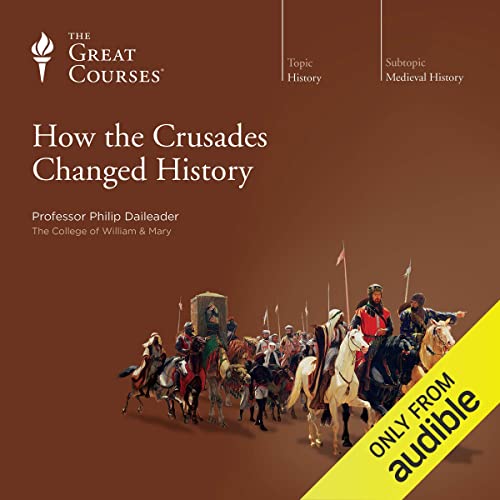
How the Crusades Changed History (The Great Courses: Medieval History)Philip Daileader8.90
Centuries have passed since the last crusader knight laid down his sword, but the Crusades continue to hold sway over our world. Because the Crusades have been so consequential to history, it's essential to understand the context, motivations, and preconditions of these dramatic military campaigns. In doing so, you'll not only get a fresher understanding of the Crusades, you'll discover surprising truths about why (and how) they were fought. More than just an enriching recount of events, this series of 24 lectures is an intellectually rewarding exploration of how the Crusades shaped the medieval world and laid the seeds for our own. Plunging you into the series of Crusades to the Holy Land and elsewhere - from the calling of the First Crusade in 1095 to the collapse of the Kingdom of Jerusalem, in 1291 - Professor Daileader's lectures are filled with eye-opening insights and gripping stories that will help you reach your own conclusions about just how important these centuries of warfare were to the story of human civilization.
The Age of Louis XIV (The Story of Civilization)Stefan Rudnicki9.50
Publisher's Summary The Age of Louis XIV is the biography of a period (1648 - 1715) that Spengler considered the apex of modern European civilization. "Some centuries hence," Frederick the Great correctly predicted to Voltaire, "they will translate the good authors of the age of Pericles and Augustus." Those authors are lovingly treated here: Pascal, Racine, and Boileau, Madame de Sévigné, Madame de la Fayette, and above all the philosopher-dramatist Molière, who so memorably exposed the vices and hypocrisies of the age. Central to the audiobook is the "Sun King" himself, Louis XIV. Louis XIV ruled France for over seventy years, longer than almost any European ruler in history. He is the subject of a character study that runs through seven chapters, revealing the flesh and blood beneath the purple and the crown. He is seen at his worst in his struggle with Jansenists and Huguenots, at his best in his patronage of literature and art, and at his most human in his love affairs with Henrietta Anne of Orléans, Louise de La Vallière, Madame de Montespan, and Madame de Maintenon. From France the narrative passes to the Netherlands, and after pausing to examine the domestic idylls of Vermeer, shows the Dutch opening their dikes to save their land from Louis XIV and sending William of Orange to become king of England and a leader of the European alliance against Louis' hegemony. In England, we contemplate the heyday of virtue under the Puritans and study the strange character of Cromwell. We see Milton's passionate career as part of the vain effort to prevent the Stuart Restoration. We find Charles II, the "Merry Monarch", with more manners than morals, attend boisterous Restoration plays; we skim the diaries of Evelyn and Pepys; and we follow Jonathan Swift from genius to insanity. Crossing the North Sea, we trace the tragic heroism of Charles XII of Sweden and the attempt of Peter the Great to lead Russia from barbarism to civilization. ©1963 Will and Ariel Durant (P)2015
Magna CartaDan Jones9.10
Publisher's Summary From the New York Times best-selling author of The Plantagenets , a short, lively, action-packed history of how the Magna Carta came to be. The Magna Carta is revered around the world as the founding document of Western liberty. Its principles can be found in our Bill of Rights and in the Constitution. But what was this strange document that dwells on tax relief and greater fishing rights, and how did it gain legendary status? In this 800th anniversary year, Dan Jones takes us back to 1215, the turbulent time when the Magna Carta was just a peace treaty between England's King John and a group of self-interested, violent barons who were tired of his high taxes and endless foreign wars. The treaty would fail within two months of its confirmation. But this important document marked the first time a king was forced to obey his own laws. Jones' Magna Carta follows the story of the Magna Carta's creation, its failure, and the war that subsequently engulfed England and is an audiobook that will appeal to fans of microhistories of pivotal years like 1066, 1491, and especially 1776 - when American patriots, inspired by that long-ago defiance, dared to pick up arms against another English king. ©2015 Dan Jones (P)2015 Penguin Audio
Loading more

Loading more

LibraryNovelAudioCategoryMe